How to drain a water heater and flush sediment
Hard Buckeye water leaves sediment in your tank. Here's how to drain and flush it yourself, what it costs in 2026, and when to call a pro.
Draining a water heater and flushing sediment means shutting off the gas or power, closing the cold inlet valve, connecting a hose to the drain valve, and running the tank empty until the water comes out clear instead of milky or gritty. In Buckeye, you should do this once a year - twice if your home sits on the west side where the water runs hardest. The whole job takes about 45 to 90 minutes on a standard 40- or 50-gallon tank. Below we walk through the exact steps we use on service calls, what 2026 pricing looks like if you'd rather hand it off, and the mistakes that turn a simple flush into a flooded garage.
Why Buckeye water heaters build up sediment so fast
Buckeye's municipal water supply comes out of the ground with high mineral content - calcium and magnesium mostly - and that hardness is what settles to the bottom of your tank as sediment. The Colorado River and groundwater blend that feeds most of the West Valley runs roughly 12 to 18 grains per gallon, which is firmly in the hard-to-very-hard range.
Every time the burner fires, those dissolved minerals precipitate out and drop to the tank floor. Sand and grit from the main lines ride along too. On a 50-gallon tank heated to 130°F, you can accumulate a quarter-inch of scale in a single year. After three years, it's a half-inch or more, and the bottom element on an electric tank is buried in it.
Sediment is a problem for two reasons. It insulates the water from the burner, so the tank runs longer and burns more gas or pulls more amps to hit the same temperature. And it traps water underneath it, which superheats and makes the popping and rumbling sound you hear through the house at 6 a.m. That noise is steam escaping through the scale layer - not a good sign.
If you've already noticed rusty water, a rumbling tank, or a pilot that keeps going out, that's usually the point where water heater repair buckeye AZ is the smarter call than a DIY flush. Sediment that's been cooking for years can hide a cracked dip tube or a failed anode rod, and those need to be replaced, not rinsed.
How do I drain and flush my water heater in Buckeye AZ?
Draining and flushing a water heater in Buckeye AZ follows the same sequence whether you have a gas tank in the garage or an electric unit in a closet: kill the heat source, isolate the tank, drain it, flush it with cold water, then refill before restoring power. Skipping the order - especially turning the power back on before the tank is full - is how elements burn out.
Step 1: Shut off the heat
For a gas heater, turn the thermostat dial to the "pilot" or "off" position. For electric, flip the double-pole breaker at the panel. Do not skip this. A dry electric element will burn out in under 30 seconds and cost you $40 to $120 for the part plus labor.
Step 2: Close the cold inlet and let it cool
Find the cold water shutoff valve on the pipe entering the top of the tank and turn it clockwise until it stops. Then wait. Give the tank at least two hours to cool to room temperature. Draining 130°F water into a garage floor or a Buckeye driveway in July is a scald risk and can crack a concrete slab that's been sitting in the sun.
Step 3: Hook up the hose
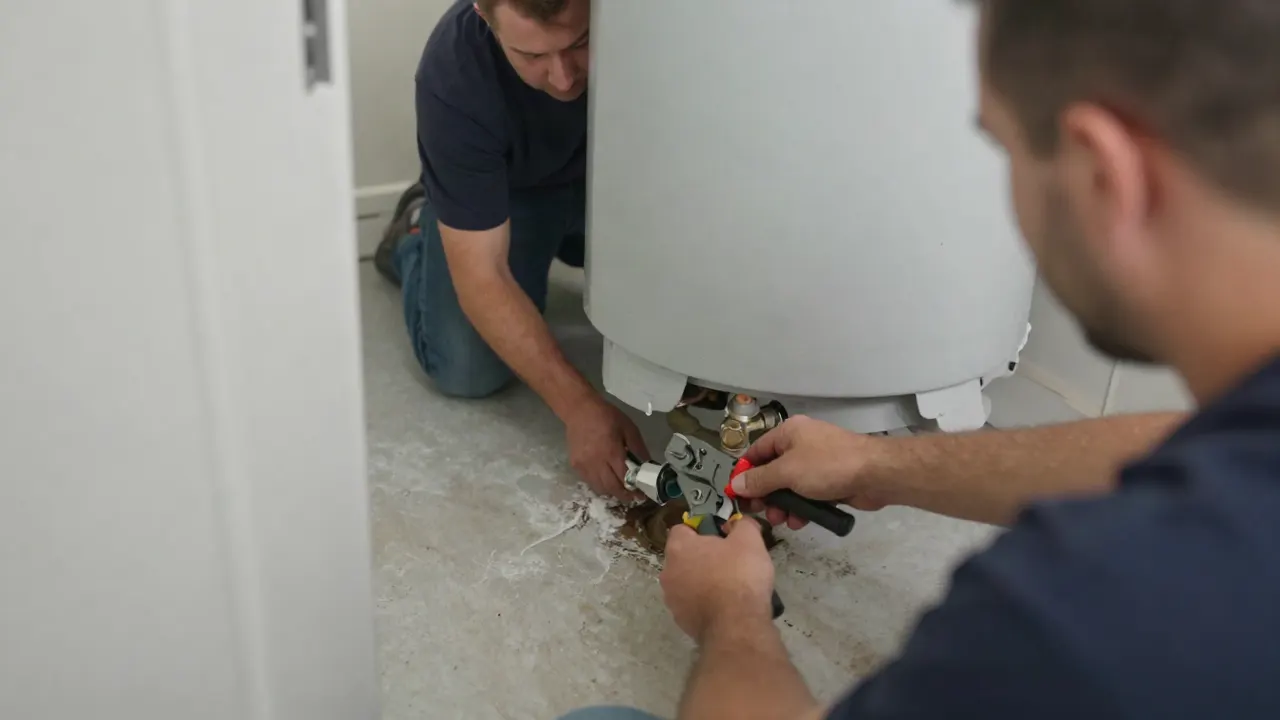
Thread a standard garden hose onto the drain valve at the bottom of the tank. Run the other end to a floor drain, a curb, or the alley - wherever your HOA or the city allows. Buckeye allows discharge to the street gutter in most residential zones, but check your specific subdivision rules first. Open a hot-water faucet at the farthest fixture (usually a bathroom sink) to break the vacuum so the tank actually drains.
Step 4: Drain the tank
Open the drain valve. On a 50-gallon tank, expect 8 to 12 minutes of full flow, then a slow trickle as the last few gallons push through the sediment. If the flow stops early, the valve is clogged with scale - close it, remove the hose, and clear the valve with a small wire or a screwdriver before reopening. This is the single most common snag on Buckeye tanks older than five years.
Step 5: Flush until clear
Once the tank is empty, close the drain valve, open the cold inlet for 30 seconds, then close it again and reopen the drain. Repeat this three or four times. You're looking for the water to run clear instead of milky or sandy. On a heavily scaled tank, you may need six or seven cycles before the discharge runs clean.
Step 6: Refill and restore heat
Close the drain valve, remove the hose, and open the cold inlet all the way. Open a hot faucet and let it run until it stops sputtering - that means the tank is full. Only then relight the pilot or flip the breaker. Wait 30 minutes and check for leaks at the drain valve and the T&P relief valve.
How often should I flush my water heater in Buckeye?
Flush your water heater once a year in Buckeye - every 12 months on the calendar, not "when you remember." If your home is west of the Agua Fria and on well water or a blended supply, do it every six to eight months instead. That's the schedule we put our own customers on, and it's the single biggest factor in how long a tank lasts here.
Two seasonal notes for the West Valley. First, flush in late fall or early winter - November through February - when the tank is easiest to cool and you're not fighting 110°F garage temperatures. Second, if you're heading out of town for the summer, do the flush before you leave. A tank sitting idle with fresh sediment and no draw for six weeks is a tank that's going to rumble when you get back.
If you'd rather not crawl around a hot garage with a hose, our team handles plumbing buckeye AZ homeowners rely on for exactly this kind of routine maintenance. We flush, inspect the anode rod, test the T&P valve, and check the drain valve for scale - usually in under an hour.
Tools and parts you'll need
You don't need much, but you do need the right pieces. Here's the list we keep on the truck for a standard flush:
- A 5/8-inch garden hose, 25 to 50 feet - long enough to reach a drain or curb
- A flathead screwdriver for the drain valve and the access panel
- A bucket or shallow pan to catch the last gallon
- Teflon tape and a spare 3/4-inch drain valve (about $8 to $15 at any Buckeye hardware store)
- Work gloves and eye protection - sediment spray is gritty and hot
- A flashlight to check the anode rod and the burner compartment
If your tank is more than eight years old, pick up a replacement drain valve before you start. The plastic factory valve on most builder-grade tanks cracks when you put a wrench on it, and a snapped valve means a tank that won't hold water until a plumber gets there.
What happens if I don't flush sediment from my water heater in Buckeye AZ?
Skip the flush and the tank fails early - usually at year six or seven instead of year ten or twelve. The sediment layer does three things at once: it insulates the burner, it traps water that superheats and cracks the glass lining, and it clogs the drain valve so the next person who tries to flush it can't get anything out.
The cost math is simple. A new 50-gallon gas water heater installed in Buckeye runs $1,400 to $2,400 in 2026, depending on venting, code upgrades, and whether you go tank or tankless. An annual flush runs $125 to $225. Over a ten-year tank life, you're spending roughly $1,500 to $2,000 on flushes to avoid a $2,000 replacement - and you get lower gas bills and hot water that doesn't smell like sulfur in the meantime.
Sediment also shortens the life of everything downstream. The grit that gets stirred up travels into your fixtures and can accelerate wear on cartridges and aerators. If you're already seeing pressure drops at the showerhead, it's worth having us look at residential plumbing services buckeye AZ alongside the flush - sometimes the sediment problem is a whole-house issue, not just a tank issue.
Common mistakes to avoid
The mistakes that cause damage during a water heater flush are almost always about sequence or torque. Here's what we see on callbacks:
- Draining a hot tank. Wait the full two hours. Hot water under pressure will scald you and warp a plastic drain pan.
- Forgetting the vacuum break. If you don't open a hot faucet upstairs, the tank drains slowly or not at all, and you'll think the valve is clogged when it isn't.
- Over-torquing the drain valve. Hand-tight plus a quarter turn is enough. A wrench on a plastic valve is how you snap it.
- Restoring power before the tank is full. This is the one that costs real money. Dry-fire an electric element once and you're replacing it.
- Flushing onto a hot driveway. In a Buckeye summer, 130°F water on 140°F concrete can cause thermal shock cracks. Run the hose to a drain or a shaded curb.
- Ignoring the anode rod. The rod is what protects the tank lining. If it's more than 50% consumed, replace it during the flush - it's a $30 part and 10 minutes of work.
When to call a professional
Call a professional if the drain valve won't open, if you see rust-colored water after the flush, if the tank is over eight years old, or if you're on a second floor or in a tight closet where a spill would reach drywall. Those are the jobs where a DIY flush turns into a water damage claim.
Our team at Buckeye Desert Bloom Plumbing handles sediment flushes, anode rod replacements, and drain valve swaps as routine service. We also check the T&P valve and the expansion tank while we're there, because those fail quietly and cause the same rumbling symptoms as sediment. If your tank is already past the point where a flush will help, we'll tell you straight and quote a replacement on the spot - no pressure, no upsell.
For commercial properties - restaurants, salons, small offices - the schedule is tighter because the tank runs harder. We handle commercial plumbing services buckeye AZ with after-hours scheduling so we're not shutting off your hot water during business hours.
Frequently Asked Questions
How do I drain and flush my water heater in Buckeye AZ?
Shut off the gas or breaker, close the cold inlet, wait two hours for the tank to cool, connect a garden hose to the drain valve, open a hot faucet to break the vacuum, and drain fully. Then cycle cold water through the tank three to six times until the discharge runs clear. Refill completely before restoring power.
How often should I flush my water heater in Buckeye?
Once every 12 months for most Buckeye homes. If you're on well water or a blended supply west of the Agua Fria, flush every six to eight months. Late fall through early winter is the easiest window because the tank cools faster and garage temperatures are manageable.
How much does water heater flush service cost in Buckeye Arizona?
Expect $125 to $225 for a standard residential flush in 2026, including anode rod inspection and a T&P valve test. Add $30 to $60 if the anode rod needs replacing. Heavily scaled tanks or second-floor units with limited access can run $250 to $300.
What happens if I don't flush sediment from my water heater in Buckeye AZ?
The tank fails early - typically year six or seven instead of year ten to twelve. Sediment insulates the burner, traps superheated water that cracks the glass lining, and clogs the drain valve. You'll also see higher gas bills and rusty or sulfur-smelling hot water before the tank finally leaks.
Can I flush a tankless water heater the same way?
No. Tankless units need a descaling pump and a vinegar or citric acid solution circulated through the heat exchanger for 45 to 60 minutes. The process is different enough that we recommend a pro for the first one. After that, many homeowners do it themselves annually with a $150 pump kit.
Get help with plumbing in Buckeye
If your tank is rumbling, your hot water is rusty, or you'd rather not spend a Saturday wrestling a hose in a hot garage, we'll take it from here. One call, one visit, and your water heater is flushed, inspected, and running quiet again.
Call Buckeye Desert Bloom Plumbing at (928) 495-5111 to schedule your water heater flush or ask about our annual maintenance plan.