Why is my water heater leaking from the bottom
A water heater leaking from the bottom is usually a failed tank, not a loose fitting. Here is how to tell the difference and what it costs to fix in Buckeye.
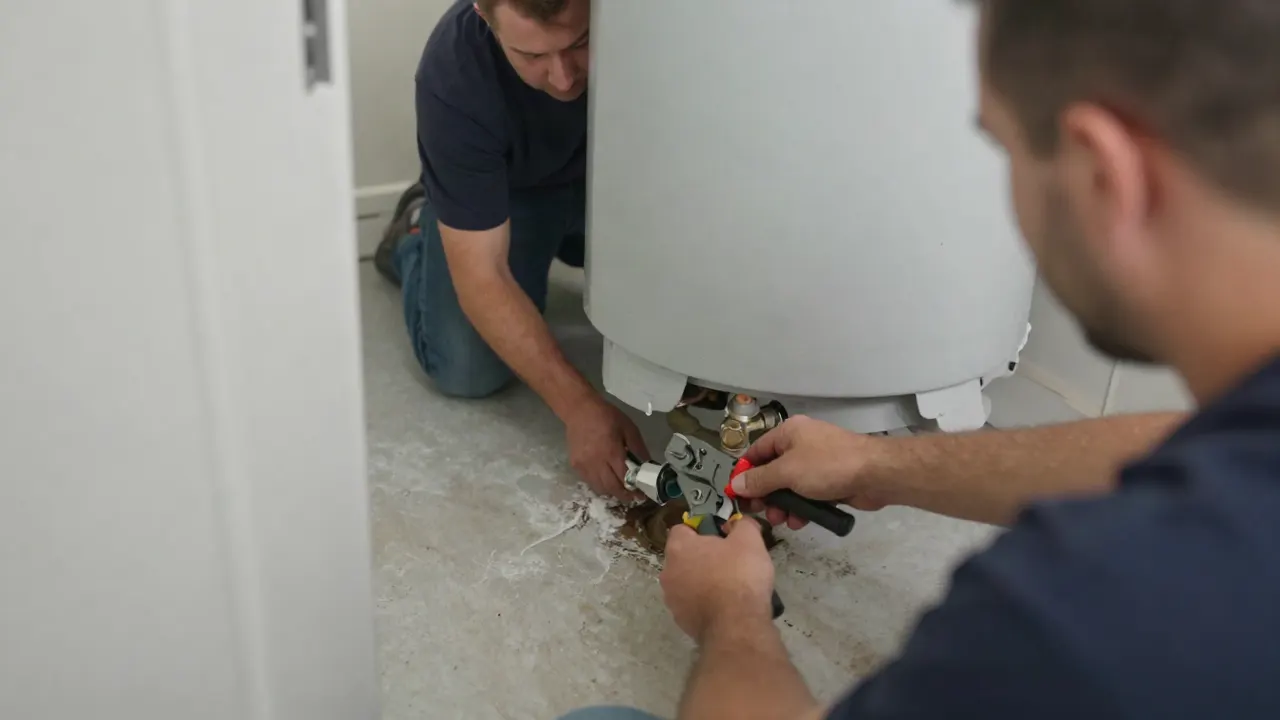
A water heater leaking from the bottom is almost always a failed inner tank, not a loose fitting you can tighten. Once the steel tank itself cracks or rusts through, no amount of pipe tape or sealant will stop it - the tank has to be replaced. If you are seeing water pooling under the unit right now, shut off the cold water supply valve on top of the heater and cut power at the breaker or gas valve before you do anything else.
We run into this call constantly in Buckeye, and the answer is usually the same: the tank is done. Below we break down every cause of a bottom leak, how to confirm which one you have in about five minutes, what repair and replacement cost here in 2026, and the mistakes that turn a $1,200 job into a flooded garage.
The short answer: bottom leaks are almost never the fitting
Water that appears at the base of a tank-style heater comes from one of five places, and four of them are cheap fixes. The fifth - a cracked or rusted tank - is not. A water heater leaking from bottom in Buckeye AZ is a plumbing failure that means the pressure vessel holding 40 to 80 gallons of hot water has lost its integrity, and that is a replacement, not a repair.
Here is the part most homeowners miss: water travels. A leak at the top fitting can run down the side of the tank and pool at the bottom, making it look like a tank failure when it is really a $15 nipple and a half-hour of labor. That is why we never quote a replacement over the phone. We look first.
Why is my water heater leaking from the bottom in Buckeye AZ?
Five things cause water at the base of a water heater in Buckeye, and the location of the moisture tells you which one you are dealing with.
1. A cracked or rusted inner tank
This is the big one. The steel tank inside your heater is lined with glass to keep water off the metal. That lining cracks from thermal expansion - the tank heats, cools, heats, cools, hundreds of times a year. Once water touches bare steel, rust starts, and rust becomes a pinhole, and a pinhole becomes a puddle. A leaking tank cannot be welded, patched, or sealed from the outside. The water is coming through the wall of the vessel.
2. A failed drain valve
The drain valve sits at the very bottom of the tank, and it is the most common false alarm we see. The plastic or brass valve gets bumped, mineral deposits chew up the washer, and it drips. This one is genuinely repairable - we drain the tank, swap the valve, and you are back in business for a fraction of replacement cost.
3. A leaking T&P relief valve or drain pan
The temperature and pressure relief valve is on the side or top, but when it weeps, water follows the tank down to the floor. Same with a cracked drain pan - the pan holds water until it does not, then it looks like the tank is leaking. Both are diagnostic traps.
4. Loose inlet or outlet connections
The nipples and unions where the cold line enters and the hot line exits can loosen or corrode. Water runs down the tank jacket and pools at the base. Tightening or replacing these fittings is a same-day fix.
5. Condensation (on gas units, in winter)
If you have a gas heater and the leak only shows up after a long hot shower in January, you may be looking at condensation, not a leak. Cold water entering a warm tank in a cool garage sweats. It usually clears on its own. If it does not clear within a day, it is a real leak.
How to tell a tank leak from a fitting leak in five minutes
You can narrow this down yourself before you call anyone, and it saves you money either way.
- Dry everything. Towel off the tank, the fittings, and the floor. Wait 20 minutes without using hot water.
- Watch the top first. If moisture reappears at the top fittings and runs down, you have a fitting leak - good news.
- Check the drain valve. Put a dry paper towel directly under the drain valve spout. If it wets, the valve is the source.
- Look for rust streaks. Rust-colored trails running down the tank jacket from a seam or from under the top pan point to a tank failure.
- Check the age sticker. Every tank has a serial number with the manufacture date. Tanks in Buckeye typically last 8 to 12 years. Past 12, and a bottom leak is almost certainly the tank.
If steps two through four come back clean and water is still rising from under the tank itself, stop. That is a tank failure, and continuing to run the heater risks a full rupture. We handle this as an emergency plumber buckeye call because a 50-gallon tank letting go can put 50 gallons on your garage floor in under 20 minutes.
What Buckeye's water does to water heater tanks
Buckeye's water is hard - we routinely measure 12 to 18 grains per gallon on the west side, well above the 7-grain threshold where scale starts building fast. That matters for your tank.
Every degree of hardness adds mineral load. Those minerals settle on the bottom of the tank as sediment. Sediment does two things: it insulates the burner from the water (so the tank runs hotter and longer), and it traps water against the glass lining, accelerating the corrosion that ends in a bottom leak. A tank that would last 12 years in soft water often fails at 8 or 9 here.
This is also why we push water softener installation buckeye AZ for homeowners replacing a heater. Softening the water is the single cheapest way to make the next tank last its full rated life. If you already have a softener and it is not keeping up, a water softener repair buckeye AZ visit is usually a same-day fix.
Can a water heater leaking from the bottom be repaired?
Sometimes, and the answer depends entirely on where the water is coming from. A drain valve, a T&P valve, a fitting, or a drain pan can all be repaired. A cracked or rusted tank cannot - not by us, not by anyone.
Here is the honest breakdown:
- Repairable: drain valve, T&P relief valve, inlet/outlet nipples, unions, drain pan, condensation.
- Not repairable: any leak through the tank wall, a rusted tank bottom, a cracked glass lining, a leaking tank seam.
If the tank is the problem, you are looking at replacement. That is not a sales pitch - it is physics. The vessel that holds your hot water has failed, and the only fix is a new vessel. We install both tank and tankless units, and for most Buckeye homes a standard 50-gallon tank is the right call. If you want to talk through tankless water heater installation buckeye AZ, we will walk you through the venting and gas line requirements before you commit.
One more thing worth checking while we are there: if your heater sits in a garage or closet with a floor drain that backs up when the tank drains, you have a separate problem. Clearing that line is a drain cleaning buckeye AZ job, and we can knock it out during the same visit so the new heater drains properly next time.
What water heater leak repair costs in Buckeye in 2026
Typical 2026 pricing in this area breaks down like this:
- Diagnostic visit: $75 to $150, often waived if you move forward with the repair or replacement.
- Drain valve replacement: $150 to $300 parts and labor.
- T&P valve replacement: $175 to $325.
- Fitting or nipple repair: $125 to $275.
- Standard 40-50 gallon tank replacement: $1,200 to $2,200 installed, depending on tank quality, code upgrades, and whether we need to add an expansion tank or new pan.
- Tankless replacement: $3,200 to $5,500 installed, including venting and gas line work.
Those are real ranges, not teasers. The variables that push you to the top of the range are almost always the same: an old unit with corroded fittings that fight coming apart, a missing expansion tank that code now requires, and a pan or drain line that needs to be added while the old heater is out.
If you want the exact number for your house, we quote it after we look. No surprises on the invoice.
Common mistakes we see when homeowners try to fix this themselves
We get called to clean up after these more often than you would think.
- Sealing the outside of the tank. Epoxy, JB Weld, silicone - none of it works. The water is coming through the steel from the inside. You are sealing the wrong side of the leak.
- Ignoring the leak because it is "just a drip." A tank pinhole does not stay a pinhole. Pressure and heat widen it. The day it lets go is the day you have 50 gallons in your garage.
- Replacing the heater without addressing the water. If you are on well water or hard city water, the new tank will fail the same way unless you soften or filter it.
- Not pulling the permit. Water heater replacement in Buckeye requires a permit in most cases. Unpermitted installs cause problems at resale and can void the manufacturer warranty.
- Draining the tank onto a floor with no drain. We have seen garages, finished floors, and stored boxes ruined by a DIY drain-down that went sideways.
One more: turning the heater back on after shutting off the water. If the tank is empty or partially empty and you fire the burner, you can crack the tank or burn out the element in minutes. Water first, then power.
When to call a professional
Call us when water is actively pooling, when you see rust streaks on the tank, when the heater is past 10 years old, or when you have shut the water off and cannot tell where the leak is coming from. Those are the calls where a fast diagnosis saves you a flooded floor.
Buckeye Desert Bloom Plumbing handles water heater leak repair, replacement, and the water quality work that keeps the next tank alive. We find the leak, tell you straight whether it is a repair or a replacement, and give you the price before we start. If your heater is leaking right now, shut the water off and call us - we will get someone out to look at it today.
Frequently Asked Questions
Why is my water heater leaking from the bottom in Buckeye AZ?
Nine times out of ten it is a cracked or rusted inner tank, which means replacement. The other causes - drain valve, T&P valve, loose fittings, or condensation - are repairable. Buckeye's hard water accelerates tank corrosion, so bottom leaks show up earlier here than in softer-water cities.
Can a water heater leaking from the bottom be repaired in Buckeye?
Only if the leak is at the drain valve, T&P valve, or a fitting. A leak through the tank wall itself cannot be repaired by anyone - the vessel has failed and must be replaced. We confirm which one you have before quoting anything.
How much does water heater leak repair cost in Buckeye, Arizona?
Repairs run $125 to $325 depending on the part. Full replacement of a 40-50 gallon tank runs $1,200 to $2,200 installed in 2026. Tankless replacement runs $3,200 to $5,500. Diagnostic visits are $75 to $150 and often credited toward the work.
Should I replace my water heater if it leaks from the bottom in Buckeye AZ?
Yes, if the tank itself is leaking. A bottom tank leak means the steel has failed, and no repair will hold. If the heater is over 10 years old, replacement is the right call even if the leak turns out to be a fitting.
How long does a water heater last in Buckeye?
Eight to twelve years on Buckeye's hard water, versus twelve to fifteen in softer areas. Annual flushing and a water softener are the two things that get you to the top of that range instead of the bottom.
Get help with plumbing in buckeye
If your water heater is leaking from the bottom, shut off the water and call us at (928) 495-5111. We will diagnose it fast, tell you whether it is a repair or a replacement, and get your hot water back on.