How to unclog a kitchen sink drain without chemicals
Skip the caustic drain cleaner. Here are the safe, effective ways to clear a kitchen sink clog in Buckeye AZ, plus what causes them and when to call a pro.
You can clear most kitchen sink clogs without chemicals by mechanically breaking up the blockage with a plunger, a drain snake, or a baking soda and vinegar flush. Start with the plunger, then move to the snake if water still stands. Chemical drain cleaners are rarely necessary and often make the problem worse.
We handle kitchen sink clogs across Buckeye every week, and the same three culprits show up again and again: grease, food scraps, and soap scum. Below we walk through the exact steps we use, the local causes we see in Buckeye homes, what it costs if you'd rather have us do it, and when a clog is actually a sign of a bigger drain problem.
Why chemical drain cleaners are a bad idea
Chemical drain cleaners are caustic or oxidizing liquids that generate heat to dissolve organic matter. They can clear a slow drain temporarily, but they damage pipes, harm your plumbing fixtures, and pose a serious safety risk in a kitchen where food is prepared.
Here's what we see in the field. The active ingredient in most store-bought cleaners is sodium hydroxide or sulfuric acid. Both are corrosive. They eat through grease, but they also eat through the inside of older pipes, especially the PVC and ABS lines common in Buckeye homes built before 2010. Repeated use etches the pipe walls, which gives future clogs more surface area to grab onto. It's a cycle that ends with a replacement.
There's also the splash risk. If the drain is fully blocked, the chemical sits in the trap and can back up into the sink when you run water. That's a burn hazard in a room where you're washing vegetables and handling dishes. And if you end up calling us anyway, we have to treat the standing water as hazardous waste, which slows the job and adds cost.
For a safer, faster fix, mechanical methods work better on kitchen clogs because the blockage is usually solid - grease, rice, coffee grounds, eggshells - not something a liquid can dissolve evenly.
What causes kitchen sink clogs in Buckeye
Kitchen sink clogs in Buckeye are caused by grease, food particles, soap scum, and in some neighborhoods, mineral-heavy water that accelerates buildup inside the pipes. The combination is what makes them stubborn.
Grease is the number one offender. It goes down as a liquid, cools in the trap or the horizontal run, and hardens into a waxy plug. Every subsequent bit of food sticks to it. In Buckeye, where summer kitchen drain lines can sit in 100°F-plus ambient heat and then cool overnight, that grease sets up fast.
Hard water is the second factor. Buckeye municipal water and the groundwater in surrounding areas carry dissolved calcium and magnesium. Those minerals deposit on the inside of pipes and on the rubber flaps of your garbage disposal, narrowing the opening over time. A drain that was fine two years ago can start backing up because the effective diameter has shrunk by a third.
Older homes in the original Buckeye townsite and around Historic Downtown often still have cast iron drain lines. Cast iron roughens with age and snags debris. Newer builds in Verrado, Tartesso, and Sundance use PVC, which is smoother but still collects grease at every fitting.
If your kitchen drain clogs are happening more than once every few months, that's not a one-off. That's a line that needs to be cleaned properly. Our drain cleaning buckeye AZ service clears the full run, not just the trap, and we can camera the line to see what's going on.
Tools and supplies you already have
You don't need a specialty kit. Most of what works is already in your kitchen or garage.
- Cup plunger - the flat-bottom kind, not the bell-shaped toilet plunger. A cup plunger seals over the drain opening and pushes water with enough force to dislodge soft clogs.
- Drain snake (hand auger) - a 15- to 25-foot manual snake with a crank handle. This is the single most effective tool for kitchen clogs.
- Bucket and towels - you'll be removing the P-trap, and it holds water.
- Channel-lock pliers or a pipe wrench - for the slip nuts on the trap.
- Baking soda and white vinegar - for maintenance flushes, not for fully blocked drains.
- Boiling water - works on grease, but only after you've mechanically cleared the line.
If you don't own a drain snake, they run $20 to $40 at any hardware store in Buckeye. That's cheaper than one bottle of chemical cleaner and it lasts for years.
How to unclog a kitchen sink drain without chemicals: step by step
Work through these steps in order. Stop as soon as the drain runs clear.
Step 1: Plunge first
Fill the sink with about 3 inches of water. If you have a double sink, seal the other drain with a stopper or a wet rag - otherwise you'll just push water into the adjacent basin. Place the cup plunger over the drain and plunge firmly 15 to 20 times. Keep a good seal. Then pull the plunger up quickly on the last stroke to break the clog loose.
If the water drains, run hot water for two minutes to flush the line. If it doesn't, move on.
Step 2: Remove and clean the P-trap
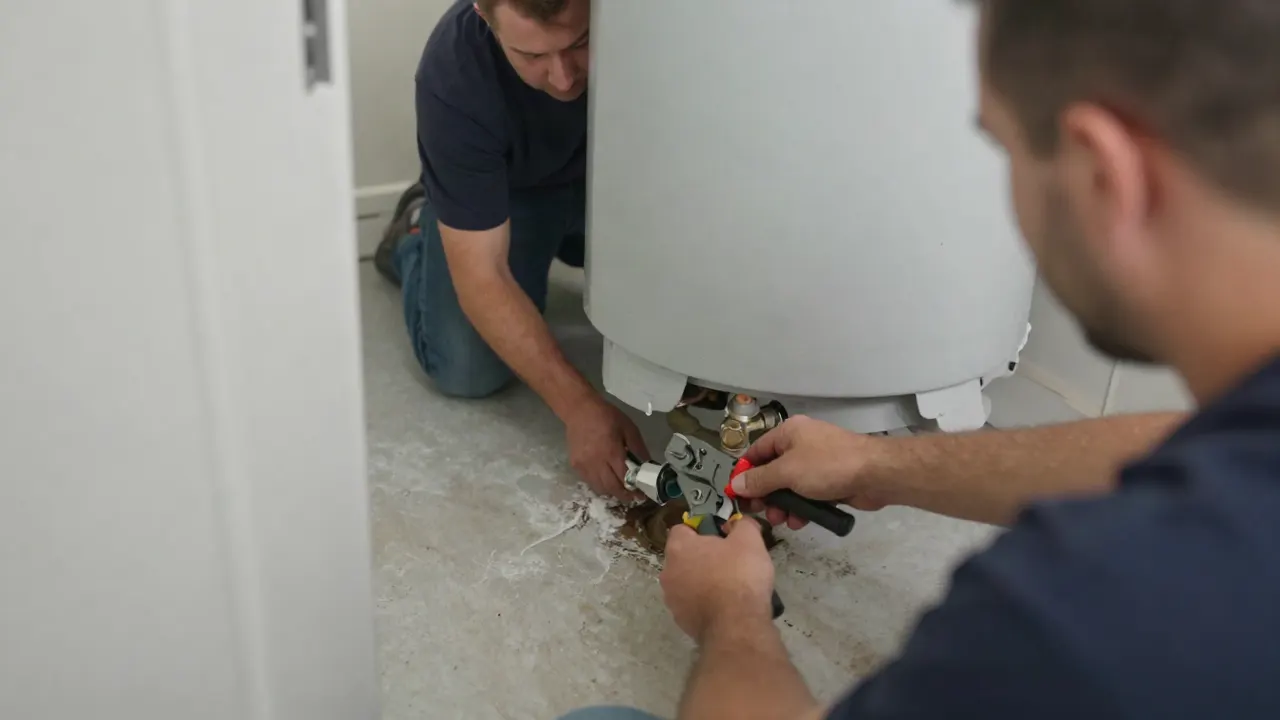
Put the bucket under the trap. Loosen both slip nuts by hand or with pliers. Pull the trap off and dump it into the bucket. Most kitchen sink clogs in Buckeye are sitting right there - a gray, greasy mass of food and soap. Clean the trap with a bottle brush and hot water, then reinstall it hand-tight.
If the trap was clear, the clog is further down the line. That's when you snake.
Step 3: Snake the drain line
Feed the snake cable into the drain opening or into the pipe stub after removing the trap. Crank clockwise as you push. You'll feel resistance when you hit the clog. Keep cranking and pushing until the cable breaks through. Then pull the cable back out slowly, wiping it with a rag as it comes.
Run hot water for three to five minutes to flush the loosened debris through the system. If the drain still runs slow, repeat the snake pass.
Step 4: Flush with hot water
Once the drain is clear, fill both basins with hot tap water and let them drain at the same time. This scours the line. Do this once a week for a month after a bad clog to keep grease from re-accumulating.
Natural drain unclogging methods that actually work
Baking soda and vinegar is the most popular natural drain unclogging method, and it works well on slow drains and maintenance, not on fully blocked ones. The reaction creates pressure and mild agitation that loosens soft buildup.
Here's the ratio we recommend: half a cup of baking soda down the drain, then half a cup of white vinegar. Cover the drain with a stopper. Let it sit 15 minutes. Then flush with a kettle of boiling water. Do this monthly.
For grease clogs, boiling water alone can help. Bring a full kettle to a boil and pour it down the drain in two or three stages, letting it sit 30 seconds between pours. This melts the grease and moves it down the line. Don't use this method on PVC if you've just run cold water - thermal shock can crack older plastic. Let the pipe come to room temperature first.
Enzymatic drain cleaners are the one commercial product we do recommend for maintenance. They use bacteria to eat organic residue. They're slow - 12 to 24 hours - but they're safe for pipes and septic systems. Use them monthly in kitchen drains that see a lot of cooking grease.
If you're dealing with recurring clogs across multiple fixtures, the issue may be the main line, not the kitchen branch. Our sewer line cleaning buckeye AZ service uses high-pressure jetting to clear the full lateral from the house to the city main.
Common mistakes to avoid
These are the errors we see most often when homeowners try to clear a kitchen sink clog themselves.
- Using a toilet plunger. The bell shape doesn't seal over a kitchen drain. You'll just splash water.
- Pouring chemical cleaner after a snake. If the snake didn't clear it, the line is still blocked. Chemical will sit there and can back up.
- Over-tightening the P-trap slip nuts. Hand-tight plus a quarter turn is enough. Crank them down and you'll crack the plastic washer.
- Running the garbage disposal as a fix. If the drain is clogged downstream, the disposal just pushes water and food into a blocked line. It backs up into the other basin.
- Ignoring a slow drain. A drain that takes 30 seconds to clear is already 50% blocked. Fix it before it stops completely.
- Pouring grease down the drain "with hot water." It still cools and hardens in the trap. Pour it into a can and throw it away.
If you've made it through the steps above and the drain still won't clear, the clog is likely past the reach of a hand snake. That's when a professional auger or jetter is the right tool.
When to call a professional
Call a professional when the drain backs up into a second fixture, when you smell sewage, when you've snaked 25 feet and hit nothing, or when the same drain clogs more than twice in six months. Those are signs the blockage is in the main line or that the pipe itself is damaged.
At Buckeye Desert Bloom Plumbing, we clear kitchen sink clogs with commercial augers and hydro-jetting, then camera the line to confirm it's actually clear. No guesswork, no repeat visits. We also check the vent stack - a blocked vent will make a drain slow even when the pipe is clean, and it's the one thing most homeowners never think to look at.
If your kitchen sink shares a wall with a bathroom or laundry, and those fixtures are also draining slow, the problem is almost certainly in the shared branch or the main. That's a same-day fix for us, not a weekend project for you.
For plumbing repairs beyond the drain - a leaking trap, a failing disposal, a corroded pipe stub - our plumbing repairs buckeye AZ team handles the whole job in one visit.
Frequently Asked Questions
How do I unclog a kitchen sink drain without chemicals in Buckeye AZ?
Plunge first with a cup plunger and 3 inches of water. If that fails, remove the P-trap and clean it, then snake the branch line with a 15- to 25-foot hand auger. Flush with hot water when clear. Most kitchen clogs in Buckeye clear at the trap or within 10 feet of the drain.
What causes kitchen sink clogs in Buckeye?
Grease, food scraps, soap scum, and hard water minerals. Buckeye's water carries calcium and magnesium that coat pipe walls, and summer heat makes grease harden faster in the trap. Older cast iron lines in the historic downtown area snag debris more than newer PVC.
Do you offer chemical-free drain cleaning in Buckeye Arizona?
Yes. We use mechanical augers and high-pressure hydro-jetting - no caustic chemicals. We camera the line after clearing to confirm it's fully open. Chemical-free cleaning is safer for your pipes, your family, and the environment.
How much does kitchen sink drain cleaning cost in Buckeye AZ?
Typical 2026 pricing in Buckeye runs $125 to $250 for a standard kitchen sink clog cleared with an auger. If the clog is in the main line and requires jetting, expect $300 to $550. Camera inspection adds $150 to $250. We quote upfront before we start.
Can I use boiling water to unclog a kitchen sink?
Yes, for grease clogs in metal or older PVC pipes. Bring a full kettle to a boil and pour in two or three stages. Don't use boiling water on cold PVC - thermal shock can crack it. Let the pipe warm to room temperature first, or use hot tap water instead.
Get help with plumbing in Buckeye
If the drain still won't clear, or you'd rather not spend your Saturday under the sink, we can be there today. Buckeye Desert Bloom Plumbing handles kitchen sink clogs, main line blockages, and everything downstream.
Call (928) 495-5111 and we'll get your kitchen back to normal. We serve all of Buckeye, from Historic Downtown to Verrado, Tartesso, and Sundance.